
What is disc golf?
Disc golf resembles traditional golf, but players use a golf disc or frisbee instead of a ball and golf club. The game starts with a golf disc being thrown from a tee area and ends when the disc has landed in a basket that acts as the hole on a golf course. The basket consists of a metal pole rising up from the ground with chains and a basket that the disc lands in. During play, the player walks up to where the disc landed and throws again until the disc is in the basket. The aim is to complete the course in as few throws as possible.

Many also call disc golf frisbee golf, since most people know a frisbee from the garden or the beach, where they've thrown it around with friends. Frisbee is, however, a registered trademark for one particular type of disc, and that's why disc golf is the correct term for the sport.
A sport for life
Disc golf is one of the most accessible sports, and it's both cheap and flexible to get started with. The vast majority of courses are free to play on, and for little money you'll have a couple of golf discs in your bag. You can play alone or in groups of 4 to 5 people. So you're not dependent on fixed practice times or coordinating with lots of people.
When you play disc golf it's most often on courses in parks or forests, where you walk a round of anything from 500-600 metres on the smallest courses to several kilometres. Along the way you throw your disc many times, so even though it doesn't lead to physical exhaustion, you move around a great deal. Disc golf shares many aspects with traditional golf and places no particular demands on either age or physical fitness. So disc golf is a sport you can play your whole life.
An outdoor activity for children and adults

How do you play disc golf?
You play disc golf on a course that typically has 9 or 18 holes. The aim is to complete the course in as few throws as possible. On each hole you throw your disc from the marked tee area, and must make your next throw where the previous throw landed. From throw to throw you may change disc, just as you may change golf club in golf. A hole is finished when you've got your disc in the basket. In disc golf the term "a hole" is also used when talking about playing from the tee to the basket.
Trees, bushes, lakes, streams and hills are all elements that help create many of the holes on the Danish disc golf courses. These elements are obstacles you have to overcome to get your disc to the basket.

Tee areas can look different and be marked with anything from two stones in the ground to a built tee area with artificial turf or paving. What they all have in common is that they mark where the hole starts. On many courses you'll find up to 3 different tee areas for each hole. Each tee area has a colour, typically white, yellow or red. The colour indicates the difficulty of the hole from that particular tee area. White is the hardest, yellow is medium and red is the easiest. New players may well start by playing from the red tee area.
The holes on a disc golf course are assigned a “par”, as is also known from traditional golf. In disc golf a par is assigned according to how many throws a skilled player is expected to need to complete the hole. Most holes are par 3, par 4 or par 5, and many new players will at first find themselves using more throws than the hole's par. Experienced players will in many cases be able to use one throw fewer than par, which is called a "birdie", and in very rare cases 2 throws fewer than par, which is called an "eagle".
Where can you play disc golf?
There are over 120 disc golf courses in Denmark that are free to play on. The easiest way to find them is to download the app "uDisc" on your phone. uDisc is the most used disc golf app in the world, and it has a map of the vast majority of courses in the world. On the map you can easily find a disc golf course nearby. It can also be used to navigate the individual courses and to keep score for both individuals and groups playing together.

Disc golf often makes use of forests and natural areas, since the surface doesn't have the same influence on the game as it does in traditional golf. Where golf courses are typically enclosed areas used only for golf, disc golf courses are often made on public land and are therefore free to play. Disc golf courses often work alongside other activities in well-used public spaces.
When you think of a fairway on a golf course, you think of large, beautiful, well-kept lawns with an even more beautiful green and a flag at the end. When you think of a fairway on a disc golf course, you often think of a winding route through a forest, with a basket at the end. That helps give players a completely different nature experience when playing disc golf.
Disc golf at many levels
Disc golf is a sport where you can go into great depth with both your technique and your equipment. While new players typically have a couple of single discs and play now and then, there are also many experienced players. You often meet them on the courses around the country, and you can see that several of them have special disc golf bags filled with golf discs.

While the majority of disc golf players play the sport at a hobby level, there are also professional players who make a living from playing disc golf. The best players have big sponsorship deals with the manufacturers of disc golf discs and equipment, as you know from golf and tennis among others. Many professional players take part in the biggest tournaments, and they're followed closely by spectators and fans who walk around the course with them.

In recent years there have been examples of professional disc golf players getting contracts worth several million kroner a year from their sponsors, in return for being allowed to produce equipment with their name on it.
How do you get started with disc golf?
It's easy to get started playing disc golf. Most people start by going out on the course themselves with friends and family, but you can also join one of the Danish disc golf clubs. The clubs typically organise practices, club evenings and tournaments where you meet other players.
In the many disc golf clubs all over Denmark you can get good help and guidance to get the best start. The clubs are most easily found via their Facebook pages, and you'll quickly find them on Facebook by searching for disc golf in your area. If you can't find a club that way, you can go to the Facebook group “Disc golf Danmark debatforum” and post there.
To start playing disc golf you only need a couple of single golf discs. In many of the online disc golf shops you'll find beginner sets with 3 discs for under 200 kr. That's plenty to get out on the course. Besides discs, the app "uDisc" is a big help. uDisc gives a complete overview of all courses in Denmark and helps keep score and show the way on the course. It's a really good tool for finding your way around.
Disc golf rules and safety on the course
To get started playing disc golf, there are only a few rules you need to know. The first throw on each hole is thrown from the marked tee area. Where the disc lands, the next throw must be made. Here the rule is that you must have contact with the ground in an area the size of an A4 sheet (about 21x29 cm) behind the disc you last threw when the next throw is made. The hole is finished when the disc lies still down in the basket, or hangs in the basket's chains. A hole isn't finished if a disc hits the chains or the basket and then falls out onto the ground.
On some courses you'll find that parts of the course are "out of bounds". If the disc lands in an area that is out of bounds, it's out of the course. It's typically paths, ponds or other areas on the course. If a disc lands in an area that is out of bounds, the player must make the next throw from the last point where the disc was in bounds. That could for example be at the edge of a pond. When the disc lands out of bounds it costs a penalty throw that is added to the number of throws the player has otherwise used to complete the hole.
As disc golf has become very popular, you can sometimes experience a bit of a queue at the individual holes. It may also be that you have to wait to make your throw because other users of the area are passing by. It's important that you don't start playing before there's room to make your throw without endangering both people and animals. This is especially the case on disc golf courses located in parks or in areas with users other than disc golf players. Here it's always the thrower's responsibility to wait to throw until there's room. You must at all costs avoid hitting anyone.
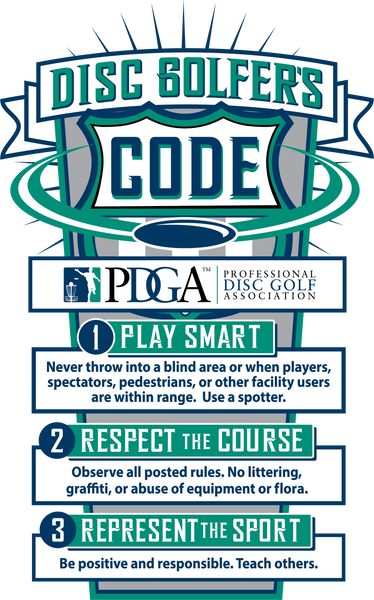
The official disc golf rules are maintained and updated on an ongoing basis by the PDGA. PDGA is an abbreviation for Professional Disc Golf Association, and you can always find the latest version of the disc golf rules on their website.
The history of disc golf
Disc golf as a sport started in the 1960s, when the first tournaments were held. As the disc golf basket had not yet been invented, people played with objects as targets. It could for example be that you had to hit a particular tree or get the disc into a bin, which served as what we today use the basket for.
In the late 1970s the rules were systematised, and both the DGA (Disc Golf Association) and the PDGA (Professional Disc Golf Association) were founded. In 1983 the first disc golf disc was made. Previously people had typically used “Frisbees”, which were one of the first commercially produced plastic discs from the manufacturer Wham-O. For that reason, many people today use the words "frisbee" and "disc" as synonyms, even though "frisbee" is a trademark for one particular disc.
The invention of disc golf is credited to Ed Headrick, also known as "Steady Ed". In 1976 he founded the company Disc Golf Association in the USA. The purpose was to produce discs, and in 1978 disc golf as we know it today was born with Ed Headrick's patent on the modern disc golf basket.

Read more about disc golf
There are many aspects to disc golf, and you can always learn more. If you're still curious, here are some references where you can read on:
-
Disc golf in Denmark
Are you curious about how disc golf has developed in Denmark over the past few years? Then you can read on in our article "Disc Golf in Denmark" and find the latest figures on the number of disc golf courses, the number of rounds played and the number of disc golf players. -
Build a disc golf course
At Disc Tree we help local enthusiasts, sports clubs, schools and everyone else who wants to build a disc golf course make their dream come true. Read more about how to get started building a disc golf course here. -
A guide to disc golf discs and flight numbers
On disc golf discs there are usually 4 numbers, which say something about how the disc is designed to fly. These 4 numbers are the disc's flight numbers, and you can read more about them in our guide to flight numbers.
-
A guide to disc golf discs and their stability
If a guide to flight numbers isn't enough, and you want to know more about why a disc behaves as it does, then our guide to stability is just the thing for you. -
Danish disc golf news
Keep up with what's happening and read news about Danish disc golf on the disc golf portal www.anhyzer.dk.